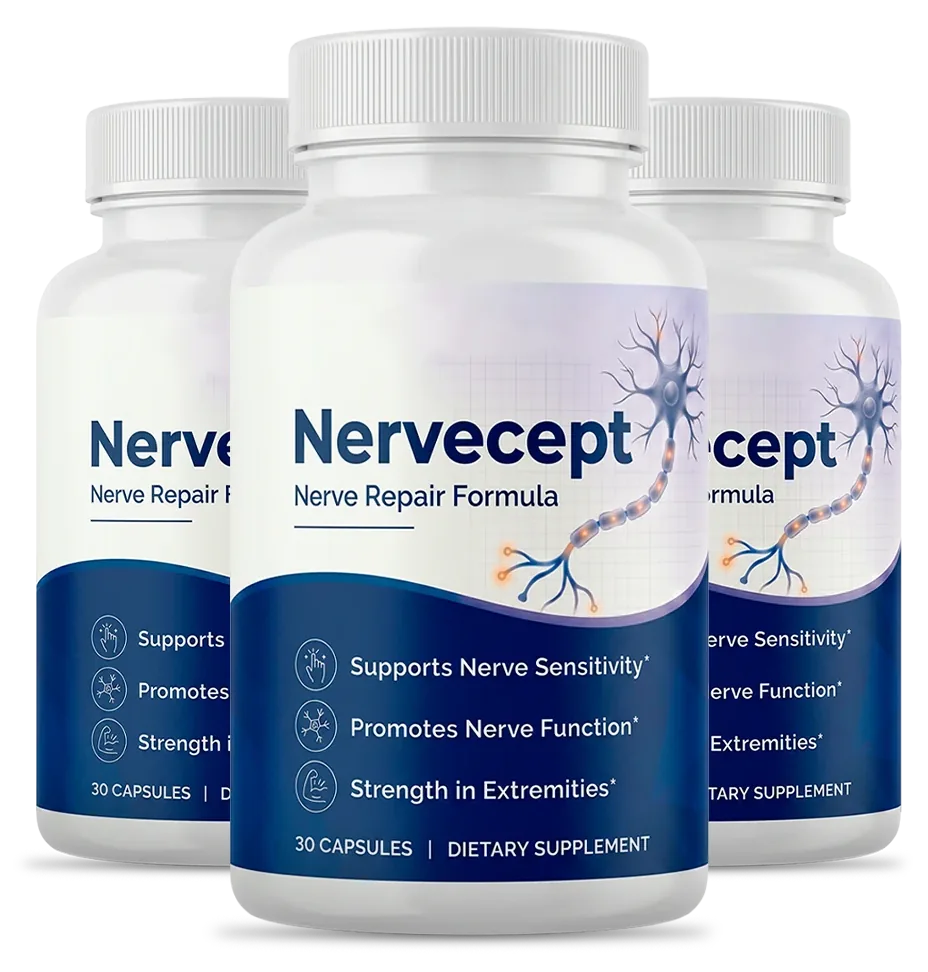
Turmeric root
Turmeric root in Nervecept
Turmeric root is the ground root of Curcuma longa, and the Nervecept label lists 50 mg per capsule. It is root, not a curcumin extract, and the knee osteoarthritis trials used curcumin products. Curcumin is poorly absorbed. Turmeric may raise bleeding risk with blood thinners, and no cited source tested it for nerves.
Written by the Nervecept label deskUpdated
What it is01
What is turmeric root in Nervecept?
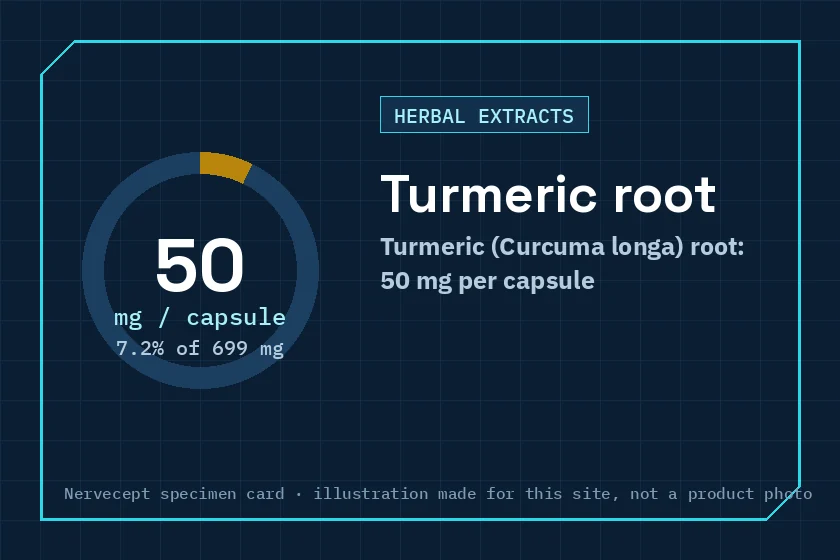
Turmeric root is the ground root of the Curcuma longa plant, the yellow spice in curry, and Nervecept lists it at 50 mg per capsule. The label reads “Turmeric (Curcuma longa)(root)”.
Curcumin is one of the active compounds in that root. It gets most of the attention in research. The label does not list curcumin, curcuminoids or a percentage, so the capsule holds plain root powder.
That detail changes how to read the research. The bottle front says “Nerve Repair Formula”, and the evidence below shows how far the turmeric line goes toward that name.
| Name on the label | Turmeric (Curcuma longa)(root) |
|---|---|
| What it is | The ground root of Curcuma longa; curcumin is one of its active compounds |
| Group on the panel | Herbal extracts |
| Amount per serving (label) | 50 mg |
| % Daily Value | Not established |
| Amount used in research | Turmeric or curcumin trials in knee osteoarthritis used curcumin products; the label lists root, not a curcumin extract |
| Strength of evidence | Initial positive signal for knee osteoarthritis; not studied for nerves |
| Marketed or traditional use | Traditionally taken for inflammation |
| Main caution | Absorption-enhanced products have been linked to liver injury; may raise bleeding risk with blood thinners; may affect liver enzymes. |
Root or extract02
Is turmeric root the same as curcumin?
No. Turmeric root is the whole ground plant part, while curcumin is one compound pulled out of it, often in concentrated form. Trials usually test the concentrated kind.
NCCIH says early evidence for turmeric or curcumin in knee osteoarthritis looks positive for pain, stiffness and function, and that better studies are needed. It finds not enough evidence for any other health use (NCCIH, Turmeric).
The Nervecept line is root at 50 mg, which is about 7% of the 699 mg listed. The sources we cite give no research amount for plain root, so we cannot say whether 50 mg matches any trial.
| Point | Nervecept label | Research on knees |
|---|---|---|
| Form | Ground root, 50 mg | Turmeric or curcumin products (NCCIH, Turmeric) |
| Curcumin amount | Not printed | Often concentrated, sometimes with an absorption aid (NCCIH, Turmeric) |
| Condition studied | Not applicable | Knee osteoarthritis |
| Nerve outcomes | Claims use “Nerve Repair Formula” | None cited |
Absorption03
How well does the body absorb turmeric?
The body absorbs curcumin poorly, because it is digested and cleared fast. A review of the research found very low levels in blood and tissue even at large doses (Anand et al., Curcumin bioavailability).
Makers try to fix this with black pepper extract (piperine), special fats or tiny particles (Anand et al., Curcumin bioavailability). The label lists none of those aids. With a 50 mg root line and no aid, the exposure is small, and we state that as a reading of the sources, not a measured result.
There is a twist. Products built for better absorption are the ones tied to liver injury, which the safety section covers.
Poor uptake
Fast breakdown and removal keep curcumin levels low (Anand et al., Curcumin bioavailability).
Trade-off
Better absorbed forms are the ones linked to liver harm (NCCIH, Turmeric) (LiverTox, Turmeric).
Safety04
Is turmeric safe for your liver and with blood thinners?
Turmeric is a well-documented cause of liver injury in some people, mostly with high-absorption products, and it may raise bleeding risk. LiverTox rates it a documented cause and says the true rate is probably 1 in 10,000 to 1 in 100,000 users (LiverTox, Turmeric).
Most cases involved concentrated curcumin, often with piperine. Onset is typically one to four months, and most people recover within one to three months of stopping, though some cases progress (LiverTox, Turmeric). Warning signs include fatigue, nausea, dark urine and yellow skin or eyes (NCCIH, Turmeric).
Memorial Sloan Kettering advises against turmeric supplements with warfarin or other blood thinners. It may also blunt aspirin and ibuprofen, and affect liver enzymes that process drugs (MSK, Turmeric).
Points in its favor
- Initial knee-osteoarthritis signal in trials of turmeric or curcumin (NCCIH, Turmeric)
- The label lists plain root, not a concentrated extract
- The amount is printed, so you can see it
Points of caution
- Bleeding risk with blood thinners (MSK, Turmeric)
- Liver injury reported with absorption-enhanced forms (LiverTox, Turmeric)
- May be unsafe in pregnancy (NCCIH, Turmeric)
Reported effects also include stomach upset, rash and hives. People prone to kidney stones should check with a doctor (MSK, Turmeric).
Before you start05
When should you ask a doctor before taking turmeric?
Ask a doctor before taking turmeric if you use a blood thinner, have liver or gallbladder trouble, are pregnant, or have surgery soon. The Nervecept capsule combines turmeric with other lines that raise their own questions.
Glucosamine and chondroitin have been tied to more bleeding in people on warfarin as well (NCCIH, Glucosamine and Chondroitin). A pharmacist can look at the full list at once.
- Stop and call a doctor for dark urine, yellow skin or eyes, or lasting fatigue and nausea.
- Keep taking prescribed medicine as directed. Turmeric is never a stand-in for it.
- Bring the whole Supplement Facts panel, not only the turmeric line.
For a view of every line, open the Nervecept ingredients guide. The bleeding questions are covered on supplements and medicines, and the side effects page covers the whole capsule.
FAQ06
Nervecept questions people ask
Is the turmeric in Nervecept curcumin?
No. The label lists turmeric (Curcuma longa) root at 50 mg, not a curcumin extract, and it prints no curcumin amount. Curcumin is one compound within the root. Most knee osteoarthritis trials tested turmeric or curcumin products (NCCIH, Turmeric).
How much turmeric is in one Nervecept capsule?
One capsule holds 50 mg of turmeric root, about 7% of the 699 mg listed. At one capsule a day, that is 50 mg daily. The sources we cite give no research amount for plain root, so we make no dose comparison.
Does turmeric help nerve pain or numbness?
No cited source shows that. NCCIH reports an early positive signal for knee osteoarthritis and not enough evidence for other uses (NCCIH, Turmeric). A doctor should check numbness or tingling that is new, spreading or constant.
Can you take turmeric with blood thinners?
Usually not without advice. Memorial Sloan Kettering advises against turmeric supplements with warfarin or other blood thinners, since preclinical work and a case report point to higher bleeding risk (MSK, Turmeric). Ask your prescriber first.
Can turmeric supplements damage the liver?
Rarely, but yes. LiverTox rates turmeric a documented cause of liver injury, mostly with high-absorption curcumin products (LiverTox, Turmeric). Call a doctor for dark urine, yellow skin or eyes, or lasting nausea and fatigue.
Why is turmeric hard for the body to absorb?
Curcumin is broken down and cleared quickly, so blood and tissue levels stay very low (Anand et al., Curcumin bioavailability). Black pepper extract is one common aid. The Nervecept label lists no such aid, so root absorption is likely modest.
Is turmeric safe during pregnancy?
NCCIH says turmeric may be unsafe in pregnancy (NCCIH, Turmeric). The Nervecept label also tells pregnant or nursing mothers to consult a physician before use. Ask your doctor before you take any capsule that lists it.
Who wrote this07
Written and reviewed by
Pages built from the label, the official site, the sales page and linked NIH, FDA, FTC and peer-reviewed sources.
Last updated . Read about our editorial standards and how we check reviews. This website is run by a U.S. order-link partner, not by the maker or distributor of Nervecept. We are paid when you buy through our order links.
Keep reading
More about Nervecept

Nervecept U.S. order-link partner
Ready to try Nervecept?
The order button opens the brand's sales page, where the order is placed and the final price and shipping are shown. Read the label, check for shellfish and check your medicines first.
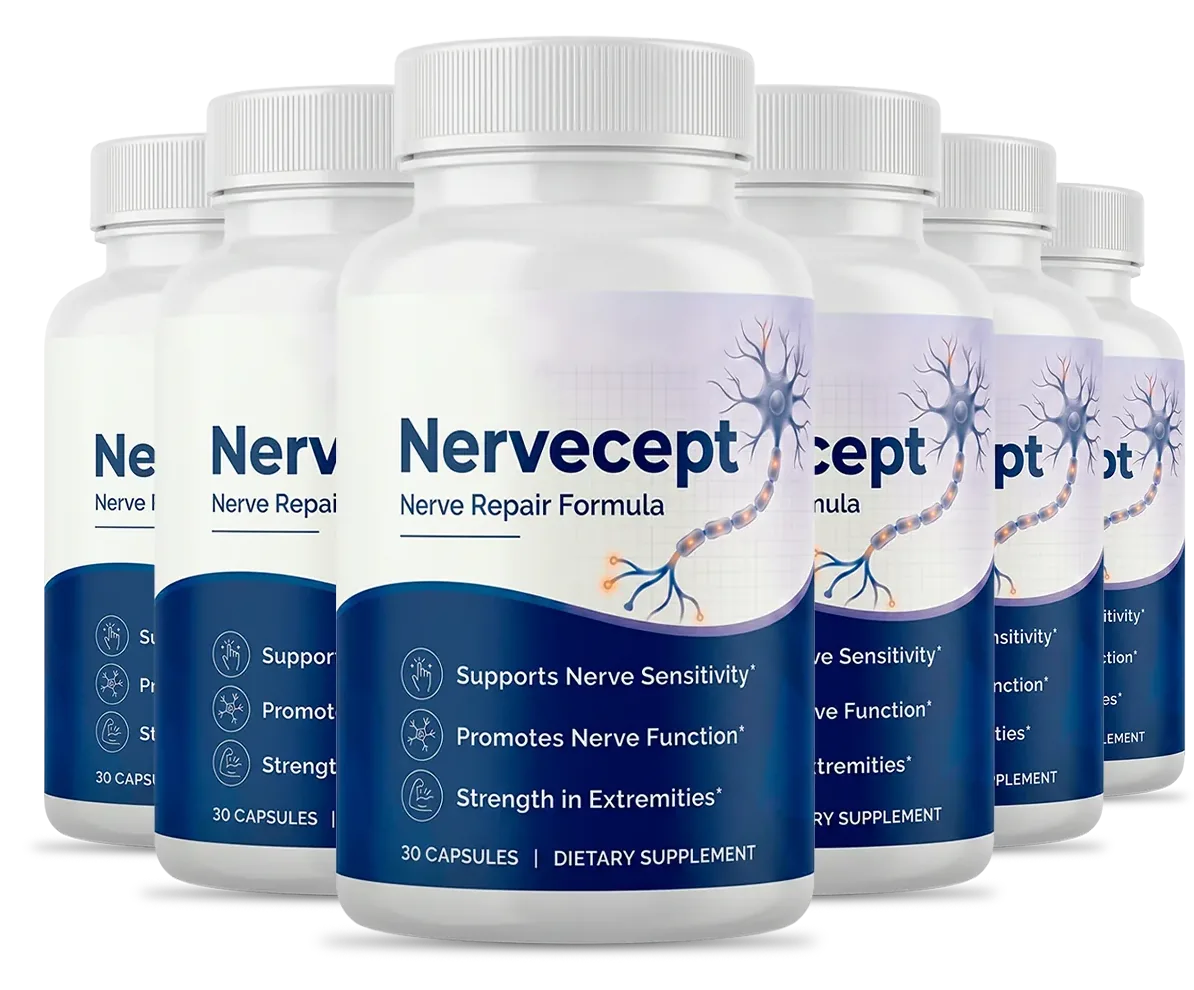
- The order button opens the brand's sales page
- 60-day money-back guarantee, as the seller states it
- Free U.S. shipping on 3 and 6 bottles